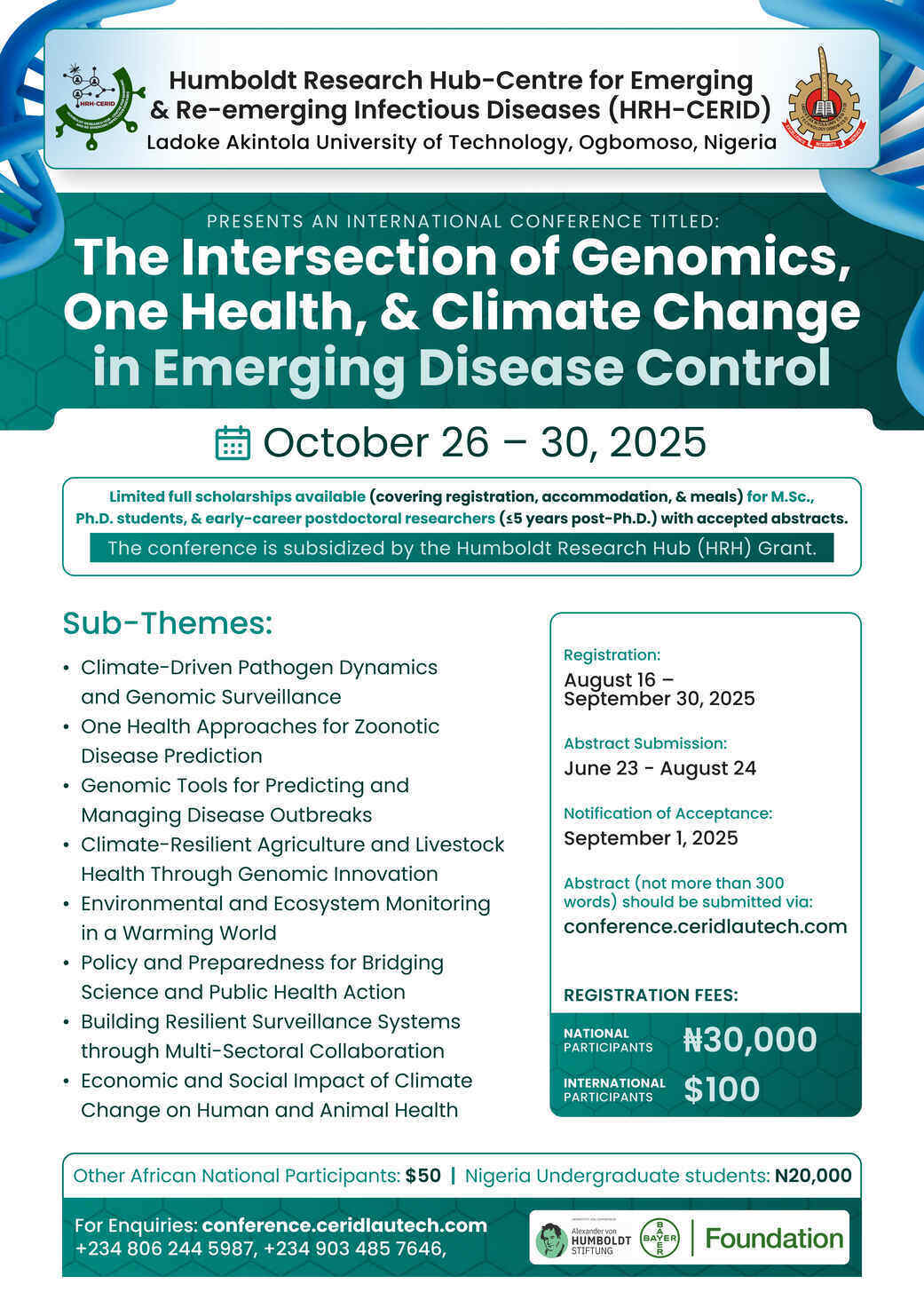
Conference Background

In the past two decades, over 70% of emerging infectious diseases (EIDs) have been zoonotic in origin, with their frequency increasing by 40% due to climate-driven ecological shifts. These diseases, fuelled by accelerating global climate change and ecosystem disruptions, pose profound challenges to global health. Rising temperatures, extreme weather events, and deforestation have intensified human-animal-environment interactions, creating fertile ground for new outbreaks.

Technological advances in genomics, however, have revolutionized our ability to confront these challenges. Genomic tools enable the rapid detection of pathogens, insight into disease evolution, and the development of targeted treatments and vaccines. When integrated with the One Health approach—a collaborative framework recognizing the interconnectedness of human, animal, and environmental health—we gain a powerful pathway to address these complex issues holistically.

This conference will convene experts from diverse fields, including epidemiology, genomics, veterinary science, environmental science, public health, and policy, to explore solutions for preventing, monitoring, and managing EIDs in the face of climate change. By combining cutting-edge genomic research with the One Health paradigm, we aim to bridge science, policy, and innovation for a healthier, more resilient world.

This conference offers an unparalleled opportunity to address one of the greatest public health challenges of our time. Join us as we chart a path toward a healthier, more sustainable future at the intersection of genomics, One Health, and climate change.
Conference Objectives

  • Understand Climate Impacts on Emerging Diseases: Explore how climate change drives EID emergence by altering ecosystems, migration patterns, and the spread of disease vectors.
  • Promote Genomic Integration in Public Health: Showcase the potential of genomic technologies in pathogen detection, genomic surveillance, and vaccine development.
  • Strengthen One Health Approaches: Highlight how One Health initiatives can mitigate zoonotic outbreaks and build climate-resilient health systems.
  • Formulate Policy Interventions: Develop strategies for incorporating scientific advancements into national and global health policies.
  • Foster Interdisciplinary Collaboration: Create opportunities for researchers, healthcare practitioners, and policymakers to co-develop actionable solutions for EID control.

Conference Values

Innovation

Promoting cutting-edge ideas and solutions

Community

Building lasting professional relationships

Education

Delivering high-quality learning experiences

Diversity

Embracing diverse perspectives and backgrounds

5

Years Running

300+

Attendees

20

Speakers

50

Countries

Organizing Committee

The team behind the HRH_CERID Conference

Prof Olusola Ojurongbe

Converner

HRH-CERID, LAUTECH

Prof Oluyinka Opaleye

Chairman, Organising Committee

HRH-CERID, LAUTECH

Prof Olugbenga Olowe

Member

HRH-CERID, LAUTECH

Prof Segun Oyedeji
Prof Segun Oyedeji

Member

FUOYE

Prof Emmanuel Egbewale

Member

HRH-CERID, LAUTECH

Prof Taiwo Ojurongbe

Member

UNIOSUN

Dr Adesola Olalekan
Dr Adesola Olalekan

Member

UNILAG

Dr Moses Ikeagbunam
Dr Moses Ikeagbunam

Member

UNIZIK

Dr Roland Funwei
Dr Roland Funwei

Member

BABCOCK

Ms Adedolapo Olorunfemi

Member

HRH-CERID, LAUTECH